

Two collaborative student projects created by students at the Creative Action Team School campus of
the Hope Public Schools recently won a total of $75 in Amazon gift cards from the Arch Ford
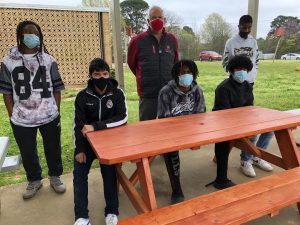
Educational Cooperative. Students in Billy Rook’s 8-12 cohort including Ty’Kendrus Harper, Ricardo
Bruno, Sidney Ross, Luis Alonzo, and Mikendrick Pugh built and sold a picnic table at a profit. Grades
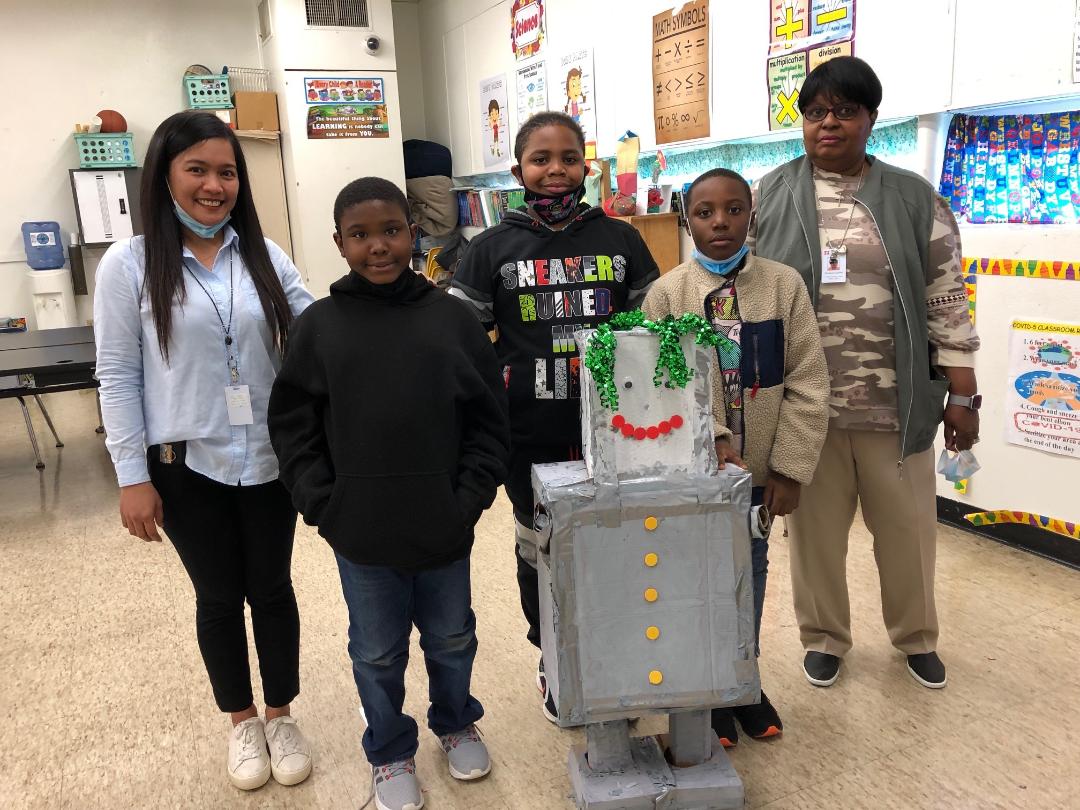
K-4 students Damarion Wesley, Demetrius Toney and LaQuan Horton of Elisa Capetillo’s class
designed and built a fantasy robot, which they displayed for CATS Principal Cleytus Coulter, right. –
Ken McLemore/Hope Public Schools
HOPE – Two projects created by students in the lower and upper cohorts of the Creative Action
Team School campus of the Hope Public Schools won a total of $75 in Amazon gift card credits
for their campus.
The awards were announced through The HUB program of the Arch Ford Educational
Cooperative. A picnic table construction and marketing project in the Larger Scale Project
category won a $50 Amazon card, while an Intermediate Project category fantasy robot design
won a $25 Amazon card, according to CATS Principal Cleytus Coulter.
CATS instructor Billy Rook directed the upper level project after coming across an idea at a
Texarkana salvage store.
“Our project became building a picnic table and selling it for a profit,” Rook said. “I bought a
picnic table kit from a salvage store; and the packaging was damaged but the wood pieces were
fine.”
Rook said he hit upon the idea of using the kit for a collaborative, cross-curricular project for his
grades 8-12 students.
“We discussed with the students that we could do this project as a manufacturing business
would,” he said. “The students built the project, calculated the cost of the materials needed,
calculated the labor used, marketed the product and calculated the profit when it was sold.”
Rook said the students handled the entire process, learning the concepts of cost versus value,
labor unit costs, and records keeping.
“Daily time sheets were logged to determine how many hours were worked and by whom,” he
said.
Students learned how to use both hand tools and small power tools during the build, and
learned aspects of math, engineering and science during planning, construction and
waterproofing of the table, Rook said.
Investing a total of $17.73 for the materials in the kit Rook provided and $11.07 in supplies used
in the production, the payoff literally came when a buyer paid $100 for the completed picnic
table.
“They made a profit of $71.20,” Rook said.
That profit was then disbursed based upon a total of 14 hours of labor resulting in each student
receiving $5.08 per unit of labor worked and eight cents in cash applied toward the next project,
he said.
The fantasy robot design was produced by Elisa Capetillo’s K-4 class, Coulter said. Using
cardboard, recycled materials, glue, duct tape and silver paint, the students built the leg, body
and head components, gave them appropriate features and produced a three-foot tall fantasy
robot.
“They took the idea and used art, math and science to learn about it,” she said. “Then, they
measured the pieces and put it together themselves.”
The two projects represent the kinds of collaborative and cross-curricular work which The HUB
program at Arch Ford fosters, according to the organization’s website.
“The HUB is designed for students to actively participate in collaborative and connected learning
environments that are technology enhanced,” the website notes.
Rook said the $50 Amazon gift card award will be used to fund a new project. Capetillo said she
will purchase a game for her classroom with the $25 card.