
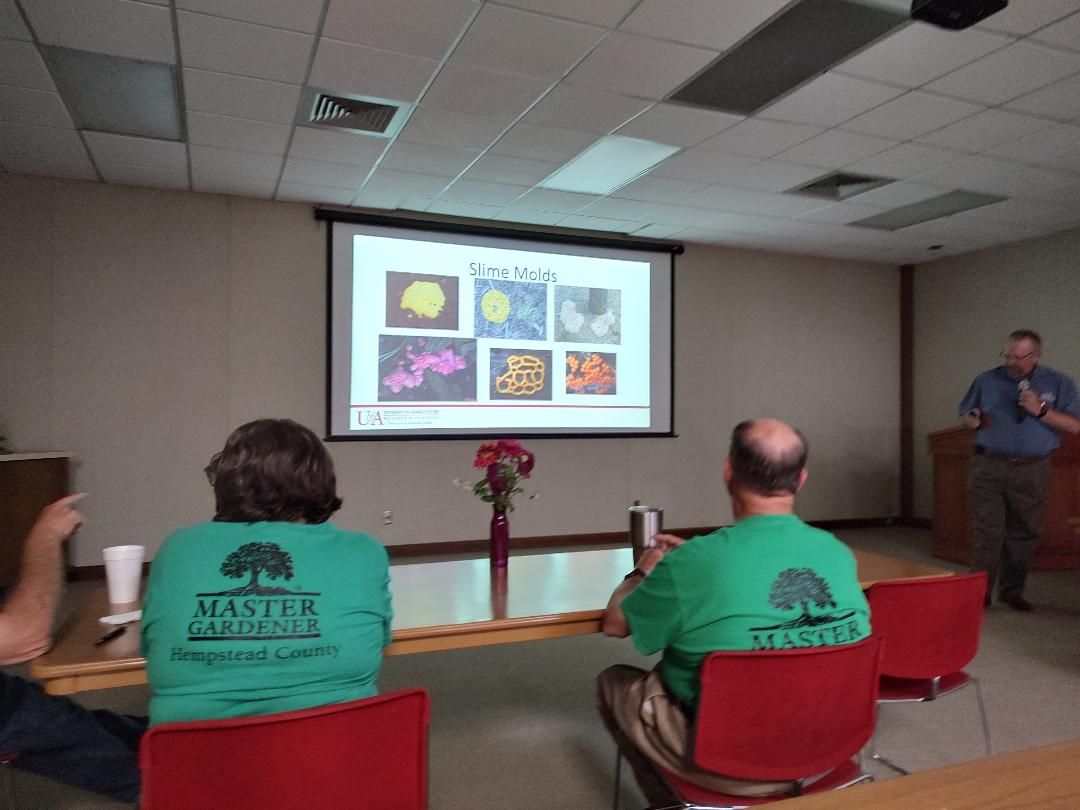

The Hempstead County Master Gardeners held a talk on mushrooms at the Southwest Arkansas Research and Experiment Station in the Conference room. Dave Philips, the President of the local chapter began the event and made introductions followed by Kim Rowe, who is both a Hempstead County Master Gardener and a Hempstead County Extension Agent introduced the local expert in mushrooms Dr. Vic Ford, Associate Vice President of University of Arkansas Agriculture and Natural Resources.
Dr. Ford talked about his roots in Eastern Tennessee, his training and who he studied with. He attended Virginia Tech and learned mushrooms in the Smoky Mountains.
Dr. Ford moved on to saying there are 10,000 species of mushrooms in Arkansas and 400 that are both edible and delicious. One of the species he mentioned were chanterelles which he said a forager must make sure not to mistake with jack-o’-lantern mushrooms were are quite poisonous.
Dr. Ford said that any mushroom can be eaten once.
Dr. Ford asked the question what a mushroom was doing in a garden and went on to describe different mushrooms. He talked about Saprophytic Fungi that aid in decomposition and nutrient cycling. He showed examples of both classes of saprophytic mushrooms: white rot and brown rot. Turkey tail is a white rot mushroom and makes good tea. Chicken of the Woods is a brown rot mushroom.
Dr. Ford also talked about Fairy Rings and said they could be over 700 years old.
Dr Ford talked about the mutualistic relationship of fungi and plants and which plants were non-microrrhizal – brassicas and aquatic plants. Mushrooms like to be damp but not wet
Without fungi most plants would have a much harder time. Mushrooms aid in carbohydrate exchange and vitamin breakdown. Without mushrooms there would be masses of undecayed plant matter
Slime molds are another type of mushroom, that start as an amoeba.
Predatory mushrooms will kill nematodes.
Ascomycota mushroom s also known as cup fungi such as yeast and lichens are another type of mushroom.
Dr. Ford talked about the value of fresh morels with them going for $30-70 per pound fresh and up to $160 dried.
Dr. Ford showed the Arkansas state mushroom – Amanita Arkansana.
Dr. Ford talked about how complex the reproduction of mushrooms is.
Dr. Ford showed images of Inky Caps and recommended getting them young and not drinking alcoholic beverages at the same time as the two do not mix well together.
Of the jelly mushrooms, ear fungus is used in sweet and sour soup.
Tooth mushrooms include Lion’s Mane and are found on trees that were struck by lightning and willows.
More information was given on distinguishing chanterelles and jack-o’-lantern mushrooms. The latter cluster, have gills and are bioluminescent.
Some puff ball mushrooms are edible while others are not. Puff balls will even grow up through asphalt.
Hypogeous mushrooms are designed to go through the digestive system.
Truffles are loved by flying squirrels. They can be found by either dog or hog. Dr. Ford recommended using dogs.
The history of Europeans and Asians eating mushrooms started with armies destroying crops and people having to figure out what they could safely eat through trial and error.
Dr. Ford talked about ways to grow mushrooms – buying spawn and innoculating or buying a kit. Kits are much more expensive. He also talked about waxes that could be used and what ones were hard to get ahold of in Hope.
As to how heavy of a log that should be used Dr. Ford said the wait should depend upon how much weight a grower was comfortable lifting. An overhead irrigation system was shown where logs don’t have to be lifted and dunked.
Dr. Ford talked about spacing the mushroom plugs – 6 inches apart and 2 or 3 inches between rows. The mushrooms won’t produce until the log is filled with the spores. Larger logs take longer to fruit but also fruit for longer. Wax on the end of the logs was discouraged as the water needs to soak into the log.
Dr. Ford asked what the difference between button mushrooms and portabellos – size and color.
Oyster mushrooms will grow on straw as the Germans found out in the aftermath of World War II.
When asked how long mushrooms are good, Dr. Ford said it was best to collect fresh mushrooms and those in the grocery store are probably good for two weeks.
There was a question and answer session at the end of the speech.