Family homestead takes familiar turn; kin follows great-grandfather’s lead

In 1870, Nevada County, Arkansas pioneer Charles Montgomery Andres acquired 100 acres in what is now the Sutton Community, which straddles County Road 31. With his wife Nancy Ann Hines Waddle, he built a two-room dogtrot house on a small rise on the edge of a pine thicket.
He cleared most of the acreage over the next several years, using timber from the land to sell to neighbors for houses and barns, creating grassland for cattle and horses and developing prime farming plots for vegetables and cotton.
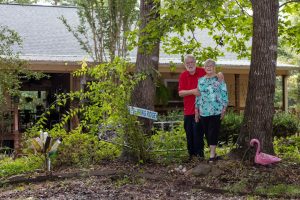
Today, on that same site, the Andres legacy has come full circle. George S. Smith, Andres’ great-grandson, and his wife Bobbie Jean built a dogtrot house that was, for a short time, a weekend and vacation getaway, but and quickly became their retirement home.
Smith remembers the old Andres house, having played in it as a boy. “I remember it as having big rooms, each with a fireplace, and this long, wide breezeway through the center,” Smith said. The site overlooked a small cattle pond where Smith and his umpteen cousins “fished, swam, built rafts and was jusr a great place to hang out” when visiting their grandparents, George Logan and Mattie Hamilton Andres.
He remembers going to the old house with his Daddy George and Uncle France (his great-uncle, Francis Marion Andres) and “sitting on the porch, resting and talking. As I grew older, those times – and that house – became almost sacred to me.”
When the family land was split between George and Mattie’s children, and later, grandchildren, Smith and his sister Andrea ended up with the 16-acre tract where the old house once stood. He said he never really thought about building there; he was busy raising a family and working in his chosen profession as a newspaper editor and publisher. (He is a former editor and/or publisher of newspapers in Arkansas, Texas, Alabama and New Mexico, including editor of the Hope Star, the defunct Texarkana Daily News and executive editor of the Texarkana Gazette.) He later worked for two Fortune 500 communications companies and a global GPS positioning company based in Japan.
He and his sister eventually sold the plot to a cousin. Soon after the sale, a logger wandered onto the land from an adjoining plot and clear-cut the site.
“The logging operation ruined the land, “ Smith said. “It looked like a slice of Vietnam after a bombing run.” With no vegetation to hold the water, the pond filled up with silt, and sycamore, elm and oak saplings, along with crosscut and saw vines, took over the landscape. “Over the years, it was a big mess, a thicket in the worst sense of the word; you could barely even walk through it.”
Smith and his wife also have their “full circle” experience. The couple first dated in 1964-’65; he was a sophomore in college, she a senior in high school. A “spite-fight,” as Smith remembers it, broke up the romance and it took 42 years for the two to reunite.
They married in September 2010 after six months of “getting to know each other again.” During the courtship, he introduced her to Sutton and she now says, “It is the most peaceful place on earth.” They arranged to purchase the 16-acre tract from the relative and immediately set to work to reclaim the land.
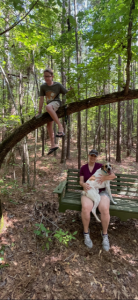
A mulching machine capable of chewing up trees up to five inches in diameter was hired and worked more than three days clearing five acres around the home site and the old pond. Additionally, the machine made a clean eight-foot swatch along the property boundary and cut four trails through the thicket. The trails have street signs with the names of the couple’s seven grandchildren and a great-niece.
The pond was reclaimed and stocked with bass, crappie, catfish and hybrid bream; it was named officially for the first time: Lake Francis Marion. “Uncle France taught me to fish, play five-hole washers washers, mumble-peg … and tell stories.”
The house is a similar style to the original Andres house – a dogtrot affair with with two, long, wide front porches (68×8 feet), two large (30×30) rooms, a smaller (30×13) sunroom/bedroom and a wide, large walk-in closet and utility room and expansive 800-square-foot back deck.
“The dogtrot design makes the perfect house for visitors,” Bobbie Jean said. “The main room serves as the living room, kitchen and dining room.” A Murphy bed and sleeping sofa create a “lot of sleeping space when family members visit.”
An enclosed outdoor shower not only “provides a unique showering experience, but also is a great place for grandkids to clean up after playing along the 1.25 miles of trails,” she said. A rock patio holds a hot tub, grill and smoker, hammock and chair swing.
Outdoor gardens, lined with rocks from the original house’s foundation and corner support piers, are filled with native and imported plants: Day lilies, gladiolas, irises, yellow rose of Texas, zennias, hostas, ferns, yarrow and assorted annuals for seasonal color.
One hillside is covered in jonquils, daffodils, paper whites and snowbells rescued from deserted home sites (with owners’ permission) and a discarded yucca plant in a county road ditch has yielded annual shoots that occupy three areas near the house and pond.
The Smiths worked hard to keep the “spirit of the land intact,” he said. Rocks and brick from the original house’s two fire places were used to create the fireplace. “A two-room cypress house more than 100 years old on the place was falling down,” Smith said. “We salvaged lumber from it to make a rustic corner piece, sofa bookcase, and fireplace mantle.”
The house is at the end of a one-lane dirt road lined with more than 30 65-year-old magnolias, planted by Smith and his grandfather. The gathering place is the front porch, with a swing, three rockers, two Adirondack chairs – all constructed from western cedar. Twin ceiling fans on the front and back porches and in the breezeway make porch-sitting comfortable even on the hottest days.
Smith, a newspaper and magazine writer for more than 50 years, has had five books published, including one titled “Reveille: A story of survival, war, family,” about his great-grandfather and his journey from New Orleans orphan to Civil War drummer boy to Nevada County landowner.
The back cover of the book shows a picture of Charles Montgomery Andres, posing with his Civil War drum … standing in front of the house that served as the inspiration for a modern dogtrot house on the tract of land now known as Andres Thicket Farm.
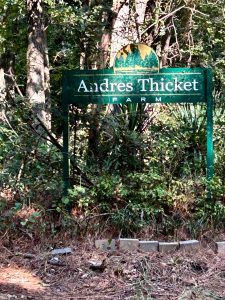
Farm? Smith smiles when asked what the couple grows: “Ticks, chiggers, thicket … and lots of love.”