
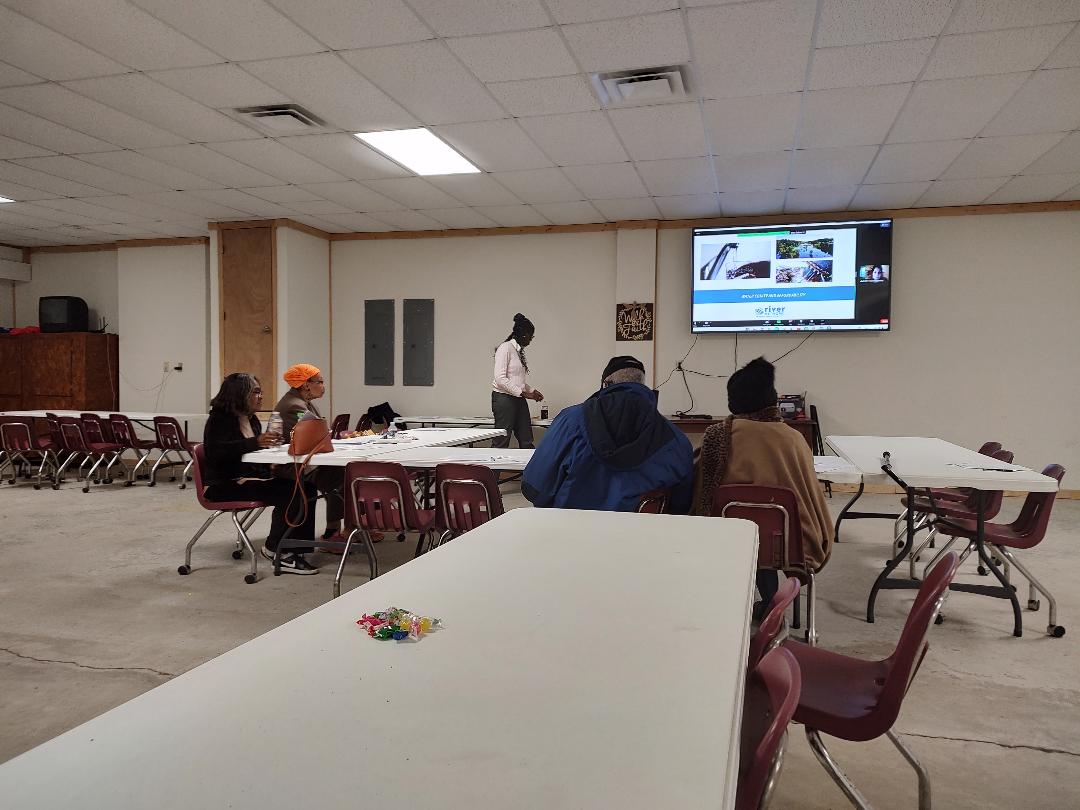

On Thursday there was a meeting of the Community Water Academy in Fulton. This event came out of the recognition of the importance of water after COVID hit and water supply didn’t always function properly.
This was the second time the community had a meeting on this topic. The panelists included Heather Himmelberger, Sylvia Brown, Stephanie Corso, Sheyda Esnaashari, Hattie Portis-Jones and Caroline Koch. April Engel and Katherine Bell were also present
Stephanie Corso is Rogue Water CEO and Co-Founder and her passion is to build bridges of trust between water providers and the communities they serve.
Caroline Koch, who facilitated the event is the WaterNow Alliance Water Policy Director.
The themes were the journey of the Water Utility and Daily Life, Water Systems Overview, Fulton Updates, Pathways for Corroboration and Q&A and Gauging Community Priorities.
The purpose of the meeting was to share and gather information about water and to establish community agreements. There is frustration as the systems have not been in place. This program is working with the EPA as the funding agency. The statement was made that the industry is starting to recognize that it is not enough to simply put in the infrastructure and forget about it.
After a brief introduction Esnaashari, the River Network Drinking Program Director started off by asking the question as to what water means to you and whether or not the participants had any special activities related to water. Water is seen as very important if it goes out or is disconnected and being life-giving.
There is goal of water equity – when all people have access regardless of drought or flooding and the statement that equity and equality are not the same.
The meeting moved onto what is covered in the water bill. The first is the capital cost – not only infrastructure. This includes new infrastructure, the replacement of old elements, and storage capacity. Included in the water bill is all this and the actual use. All of this costs money and unaffordable water bills are an issue across the country.
The Pacific Institute has come up with a definition of affordable water stating that it should be inexpensive enough so that the paying for it doesn’t interfere with any other crucial expense. It is meant to be a community level where the poverty level of the community and the unemployment rate are taken into account.
The affordability ratio is minimum wage hours needed to pay for the water bill. This doesn’t capture the debt cycle of unpaid water bills.
Himmelberger spoke on water operations. She is the Southwest Environmental Finance Center Director and has worked with water and wastewater utilities of all sizes and a variety of issues including operations and maintenance, funding, capacity building, trouble-shooting, capital improvement planning and finances.
Much of the water infrastructure was built decades ago and needs repair – it was built for different community sizes and incomes. A lot of the funding went from grants to loans. Climate change adds new needs and ends up in the water bill.
There is quite a bit of unprecedented funding with the goal of the initial amount of water at lower prices and different rates for different incomes.
The event continued on with Hattie Pottis-Jones, from Fairborn, GA. She is a third-term council member re-elected November 2021 and elected Mayor Pro-Tem. Coming from Fulton County GA Portis-Jones related her experience and the community she she lives in to that of Fulton, AR with the water loss during the snow storm here.
She stated that water is quite expensive from the perspective of both the perspective of customer and city.
Fulton County Georgia, which is reliant on water coming from Atlanta, lost water for week of Christmas. She stated that the need to communicate with the citizens was more critical now with social media for authorities to communicate what was known and what wasn’t.
Communication is key and it has to be done often and in every means possible. With COVID people became more aware of the importance of water as it proves key.
The statement was made that water as a utility is an enterprise – it is supposed to pay for itself but that has never been the case.
The statement was made that water should be a human right and that how we deliver and pay for it then becomes a lot different.
Portis-Jones stated that elected officials approve the water bills but not necessarily understand everything they approve and that the consumers had the power to make the officials understand what they needed to understand.
During the question and answer session the question was made about how much was put into the water – taste and safety. The response was that this was dependant on the water source and what the contaminants are.
The idea of breakpoint chlorine was brought up stating that chlorine mixes with everything and extra chlorine is is put in to make sure that it is safe. The statement was made that if you taste the chlorine it can actually be because the chlorine levels are too low and haven’t completely neutralized the contaminants.
A participant mentioned the dislike of the cloudiness of water and the comparison was made of bottled water. The statement was made that bottled water wasn’t natural as the water had been stripped and minerals added. The white in tap water doesn’t relate to the safety and could be calcium or other dissolved minerals. The statement was made that the consumer can communicate to the utilities about aesthetic preferences.
A water assistance program is being implemented which is modelled after the heating assistance program. It took the pandemic for people to realize how important water is.
Next covered was the Consumer Confidence Report, which is controlled by the EPA. This includes contacts and meetings and where water comes from. The report was explained, stating that Fulton’s water quality was low to medium in terms of contaminants. Certain things, such as lead, are listed whether or not there is any detectable presence. The EPA is in the process of updating regulations on reports.