

Expanding on the original article series by ACC, Rethinking Student Success: Arkansas’s Workforce Story (https://www.arkansascc.org/news)
HOPE – Built for the Workforce: Turning Education Into Opportunity
For many students at the University of Arkansas Hope-Texarkana, success has a clear destination: a career.
They come to UAHT to learn a trade, earn a professional credential, prepare for licensure, build skills for a better job, or retrain for an entirely new career. Some will spend two years working toward a degree. Others may need only a semester or a few weeks of specialized training before taking their next step.
Whatever the path, the goal is the same: helping students gain skills that have value in the workplace.
As discussed in Part One of this series, Arkansas ranked No. 1 in certificate and workforce credential completion among states participating in the Richmond Federal Reserve’s recent Survey of Community College Outcomes. Those results highlight an important role community colleges such as UA Hope-Texarkana play in connecting education directly to employment.
What Is Workforce Education?
Workforce education can take many forms.
For federal Perkins funding purposes, career and technical education programs generally lead to credentials such as a Certificate of Proficiency, Technical Certificate, or Associate of Applied Science. Unlike traditional transfer programs, these programs are designed primarily to give students the technical knowledge and hands-on skills employers need and prepare them to enter the workforce relatively quickly.
At UAHT, that approach shows up across programs designed for direct entry into high-demand careers.
Students can pursue education and training in areas such as nursing, welding, cybersecurity, AI, computer and information science, industrial electricity, HVAC, diesel technology, emergency medical services, paramedic training, teaching, fiber optics, truck driver training, and other career fields.
The programs vary in length and purpose because students and employers have different needs.
For example, a student entering welding can begin with a Certificate of Proficiency designed to develop basic welding and safety skills for entry-level employment. Students who want more advanced training can continue into the Technical Certificate in Welding Technology, where they develop skills related to structural and high-pressure vessel welding, fabrication, and layout. Those credentials can then be applied toward an Associate of Applied Science degree.
That type of pathway gives students options. They can earn a credential, go to work, continue their education, or return later to add more advanced skills.
Half of Arkansas Community College Students Choose Workforce Programs
The number of students choosing workforce education across Arkansas shows just how important these programs have become.
During the 2026 academic year, 18,585 students, or 50 percent of Arkansas students enrolled in community college credit programs, were enrolled in workforce certificate or degree programs in fields such as nursing, welding, construction, and truck driving.
Among students enrolled only in short-term certificate programs, 96.2 percent were pursuing workforce-focused credentials. Enrollment in workforce certificate and degree programs across Arkansas increased 15.9 percent from 2022 to 2026.
Those numbers represent more than enrollment growth. They represent people choosing education that can lead directly to employment and career advancement.
At UAHT, workforce preparation can begin even before a student graduates from high school.
Through the UAHT Secondary Career & Technical Education Center, participating high school students can earn college credit and work toward certificates while still in high school at no cost. Current areas of study include construction technology, electromechanical technology, information technology, medical professions, and welding. Students from high schools throughout Southwest Arkansas participate through UAHT’s Hope and Texarkana campuses.
For some students, that early start can lead directly to real-world work experience.
In 2026, four Arkansas High School juniors enrolled in UAHT’s Secondary Career Center welding program signed summer internships with Texarkana manufacturer Ledwell after completing two semesters of welding instruction. Their UAHT coursework included arc, TIG, and MIG welding, combining classroom learning with hands-on laboratory experience.
That is workforce education at its most practical: students learn skills in the classroom and lab, then apply them in an actual workplace.
Workforce Training Does Not Always Require a Degree
Credit-bearing certificates and degrees are only part of the workforce story.
Arkansas community colleges also provide noncredit Professional Skills Training for people who need to enter the workforce quickly, change careers, earn occupational credentials, or improve skills they already use on the job.
According to data reported by Arkansas Community Colleges, 10,841 Arkansans participated in professional skills training at a community college during the 2024 academic year. Community colleges accounted for 72 percent of all professional skills training contact hours reported to the Arkansas Division of Higher Education. Leading training areas included business, engineering, health professions, construction, and mechanic trades.
UAHT provides these kinds of shorter workforce opportunities as well.
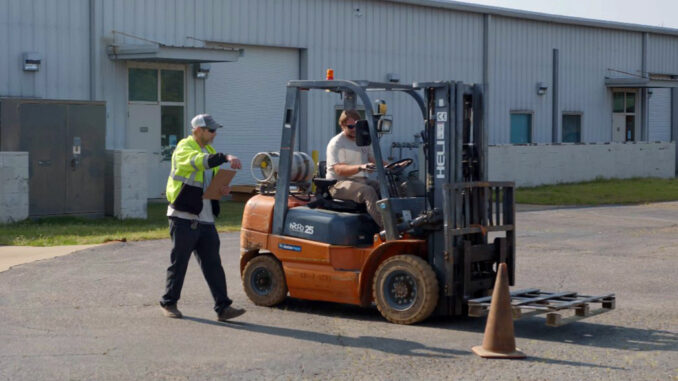
Noncredit options offered through the college have included Truck Driver Training for a Commercial Driver’s License, Forklift Certification, and Fiber Optic Technician Training. These programs provide another route for people who may not need a traditional college degree but do need specific skills or credentials to qualify for employment or advance in their careers.
That flexibility matters especially for working adults.
Someone who already has a job may not need two years of college. They may need one certification to qualify for a promotion. Another person may have been displaced from a job and need training for a new career. A local employer may need workers trained on particular equipment or skills.
Community college workforce education is built to respond to those different situations.
Connecting Education to the Regional Economy
Workforce programs work best when colleges understand employers’ needs.
That connection is especially important in a region where manufacturing, healthcare, construction, transportation, technology, skilled trades, and other industries depend on a steady supply of trained employees.
UAHT’s role is not simply to provide classes. It is to help create a connection between students who want better opportunities and employers who need people with the right skills.
That connection begins with hands-on education. UAHT values state-of-the-art equipment and hands-on experience as key parts of career preparation, allowing students to build skills in environments that reflect the work they will encounter after college.
It also means adapting as the workforce changes.
New technologies are changing nearly every industry. Employers increasingly need workers who can operate sophisticated equipment, troubleshoot automated systems, work with computers and networks, understand new energy technologies, and adapt as technology evolves.
For students, that means education cannot simply prepare them for the jobs of yesterday. It must give them practical skills they can use now and a foundation they can continue building throughout their careers.
Making Workforce Education Affordable
Preparing students for high-demand careers only works if students can afford to participate.
Arkansas has created financial assistance specifically aimed at helping students pursue workforce credentials. Programs such as the Arkansas Future Grant, commonly known as ArFuture, and the Arkansas Workforce Grant can help eligible students cover tuition and mandatory fees for qualifying certificate and associate degree programs in high-demand fields.
At UAHT, qualifying programs have included areas such as coding, computer and information science, cybersecurity, diesel technology, EMT, industrial electricity, HVAC, maintenance, nursing, paramedic, power technologies, solar technology, teaching, and welding.
For eligible parents, UAHT’s Arkansas Career Pathways Initiative can provide another layer of assistance. Career Pathways is designed to help qualifying parents gain workplace skills and earn credentials leading to employment. Depending on a student’s circumstances, assistance may include tuition, textbooks, testing fees, uniforms, supplies, childcare, transportation, technology, tutoring, academic support, and career guidance.
These resources recognize a simple reality: preparing for a better career is difficult if a student cannot afford tuition, transportation, childcare, tools, or the other expenses required to finish training.
Removing those barriers is part of workforce development too.
Success That Reaches Beyond the Classroom
When a UAHT student completes a nursing program and enters healthcare, the impact goes beyond that graduate.
When a welding student goes to work for a regional manufacturer, when an industrial technology student helps keep a production facility running, when an EMT begins serving a local community, or when an adult earns a credential that leads to a higher-paying job, the benefits extend to families, employers, and the region.
That is one of the many reasons community colleges play such an important role in workforce development.
They provide education close to home. Students can develop valuable skills without necessarily leaving their communities to do it. Employers gain access to a trained workforce. And students gain a pathway toward greater opportunity.
The statewide numbers show that thousands of Arkansans are choosing that path.
At UA Hope-Texarkana, the work happens one student at a time.
Whether the journey begins with a high school student learning to weld, a parent returning to college to enter nursing, a working adult earning a new certification, or someone preparing for an entirely new career, workforce education gives students a practical way to turn learning into opportunity.
And helping students cross that bridge from the classroom to a career is another important way the University of Arkansas Hope-Texarkana helps students succeed.
To learn more about UAHT, visit https://www.uaht.edu/index.php today.